Ira Cogan

This is my weblog. Contact: ira at iracogan dot com

The Attention Economy by Tom Chatfield, in Aeon.

Good read, here's a quote from it:

From the loftiest perspective of all, information itself is pulling the strings: free-ranging memes whose ‘purposes’ are pure self-propagation, and whose frantic evolution outstrips all retrospective accounts. This is the mountaintop view of Chesterton’s Satan, whispering in a browser’s ear: consider yourself as interchangeable as the button you’re clicking, as automated as the systems in which you’re implicated. Seen from such a height, you signify nothing beyond your recorded actions.

Vint Cerf is working on a plan to unleash AI agents on the open internet by Tim Fernholz in TechCrunch.

^This headline reads like it's a bad thing but it reads more like it's about tying AI agents to an identity like how humans on the internet are generally tied to an IP address. Also, this article is from July so it's probably old news to people who keep up with this stuff but it was news to me.


Masha Gessen in the NYTimes on NAZA

Zeeshan Aleem at MSNow on NAZA

I gotta write dedicated Masha Gessen and Zeeshan Aleem posts one of these days. They're both terrific.

I'm unlikely to see NAZA in theaters just 'cause... I don't go to the movies often to begin with and I certainly don't go to the movies to see depressing documentaries, but I intend on seeing this thing as soon as it's available at The Guardian in November.

Model Behavior: George Saunders

George Saunders and Arielle Swedback

You’ve written that your biggest fear is that we’ll enter a market so saturated that readers lose the ability to tell human writing from AI-generated writing. Do you think disclosure is an obligation to the reader? Should it become the professional norm?

I’m not sure. I guess it would only be fair (?). I think a very adept reader will be able to tell—but most of us are middling readers at best. So we might imagine a world where we were constantly being force-fed Muzak all the time, even in concert halls. Eventually the aesthetic adjusts downward. My guess is this is already happening, just from the preponderance of lite/internet/phone reading we’re always doing—I have felt it happening to me, for sure. Why do we care? Because writing changes the way we think. And the way we think makes . . . the world. If we think with compassion and become more comfortable with ambiguity and complexity and become more patient and curious—the world changes for the better. The inverse has been happening over the last 20 or so years, and I’m guessing that the coarsening of our public discourse is related to the degradation of our reading habits. Garbage in, garbage out, and then the world becomes garbage and we don’t even notice it anymore.

——-

If You Quit Social Media, Will You Read More Books? by Jay Caspian King

King on Nguyen's being “pro social media”, and how it helps you find exactly what you're looking for (my words, not Nguyen's)

I have tried similar tactics in the past, especially when I was writing about specific subjects, such as education policy or A.I. But what I found wasn’t really a sharpening of insight, but, rather, a tightened focus on the social-media consensus, which was largely dictated by the people who posted the most on any given topic. Even in moments when I wasn’t writing directly about some tweet I had seen, I was still gesturing toward it. Writing, in this form, felt more like sticking a comment bubble on an aggregated stream of news stories, social-media posts, and an assortment of video podcasts. Most pundits—at least those who comment on the world in columns, newsletters, or on podcasts—are doing some form of this. Taken together, such writing forms “the discourse.”

”...a tightened focus on the social-media consensus, which was largely dictated by the people who posted the most on any given topic.”


I don't have any insightful commentary to add but this wide-ranging interview with Saunders is fantastic and speaks to me, as does King's article about quitting social media.

-Ira

Catching Up

I had a pretty busy summer. From June 6th through September 4th, between work and other obligations I had maybe one 24 hour period without something on the calendar. Then, I took a one week staycation and my batteries are still recharged for the moment. Some years life is just like that. It’s a grind and there isn’t a lot you can do about it other than manage and that’s okay. The trick for me is when going through it, to just accept it and just do the things that need getting done and enjoy the breaks when they come. Also, this isn’t a pity party, life is great, it’s just been a busy year. That’s all. Anyway, I’m approaching the horizon of the busy year and next year is looking a little less hectic and I should have more time to get to do more of the things I actually want to do, like this.

About this AI stuff

Every day I read something interesting about AI’s capabilities and I read something stupid about the way it’s regulated. I don’t think we need an “AI Slowdown” as some are proposing, but we do need stronger regulation, and to simply enforce the laws already on the books. The ones about everything from intellectual property to privacy to consent.

For instance, if I build a robot, even one built with the intentions of helping humanity, and that robot “goes rogue” and breaks into someplace, it’s a pretty safe bet I’m going to be held responsible for that and prosecuted and that’s as it should be. That logic should still apply to software and software as a service.

Also, I don’t understand how (for instance) OpenAI makes it’s money. I know there’s a lot of money invested in it, but has it made a product that’s profitable? Right now there are a handful of companies making these things that aren’t profitable and are propping up the whole economy. It’s unsustainable. My prediction based on what little I know about this stuff is within a couple of years most of these companies’ products are just going to be another mechanism to deliver advertising and the ones that don’t go that route are going to make good products that are prohibitively expensive for most people.

and

and look, I get that some of the stuff this stuff can do is amazing, but it still costs a lot more than it produces. There’s a reason we don’t have supersonic travel. The technology has existed for decades and it ultimately was too expensive. Could there be a breakthrough in energy efficiency someday where that won’t be the case anymore? Sure. But Concorde wasn’t subsidized by tax dollars and investors the way these companies are and how that isn’t reflected in their valuations is beyond me. I’m not an economist but I know the difference between making money and losing money.

and and

I’ve been reading a lot of “Learn about AI or get left behind” stuff. Maybe, maybe not. If I find a use for it like any other new technology developed in my lifetime, sure. For instance, I resisted the mp3 file for a long time, and then I adapted when it made sense. I didn’t feel left behind. I’ve been generally late to adopt a lot of things and I never felt like I was “left behind”, and if the shit is really useful, nobody will have to be told to learn about it because they’ll want to anyway. Nobody had to tell me to learn to use a computer or email and nobody had to tell me to get a cell phone when it was time to adapt.

and and and

And that’s about it for now. I just wanted to shake the dust off this thing. ttyl

Has There Ever Been a Better Time to Be a 'Degenerate' by Nitsuh Abebe, On Language in The NYTimes

Marco Rubio is turning Venezuela into a colony by Zeeshan Aleem at MSNow

Google's AI search features pose 'unacceptable risk' to children, new report finds from PBS News, the first paragraph really says it all here:

The organization found that across more than 2,600 test interactions, Google's two built-in AI search functions, AI Overview and AI Mode, routinely failed to recognize risky and harmful behavior, answered 100% of hypothetical homework assignments students should do themselves, and provided incorrect and inconsistent responses to questions. Both AI Overview and AI Mode are built into Google Search, and cannot be disabled.

Tbh I really don't give a shit that this thing is bad at being a psychiatrist, however, I do give a shit that its inaccurate and can't be turned off. In case you missed it, I shared this related story from Techdirt yesterday. It's about how a German court recently ruled that Google is liable for false claims in it's AI overviews, as it should be.

Napalm Death's Tiny Desk Concert at NPR... And while that's a sentence I thought unlikely I'd ever type, NPR is often in touch with things that are culturally relevant to me. Anyway, awesome!

That's all for now.

-Ira

The Lo-Fi Way I Broke My Addiction to the Algorithm by Mehar Ahmad in the NYTimes (gift link). I can’t say Ahmad’s ideas would work for me, but they’re good ideas and they work for them and that’s what matters. This is another affirmation about something a lot of people are struggling with. That it isn’t just me and people are talking about it.

Why Mamdani Won’t Take off that Damn Suit by Fariha Rahman in City & State New York I enjoyed this, it’s a fun deep dive of shoe-leather reporting. I always thought to dress appropriately for the occasion whatever the occasion is. Mamdani sets an example of how to be a good person and how to present and carry yourself so you are taken seriously. It demonstrates respect and that is a thing that should be universally appreciated. And if you think this image stuff doesn’t matter, go be an idiot away from me.

German Court Says Google Is Liable For False Claims In Its AI Overviews Because They Are Its Own Words by Glyn Moody in Techdirt

The Triceratops – Candy on the Subway Crank this!

That’s all for now.

-Ira

A while back I read an interview with Cory Doctorow in The New Yorker and the whole thing is a great read, and towards the end of it Doctorow was asked about how he manages his workload and he mentioned the book Getting Things Done by David Allen. He didn't just mention it, he described the book as “life-changing”. Doctorow cranks out a lot of quality writing all the time in between everything else he does so I figured whatever he has to say about that, I ought to pay attention to. And, not only that, whether you like Doctorow or not, he does all this stuff his way. These days, he's most known for coining the term enshittification and standing up to it. The man is a literal bullshit detector, so if he's describing a book in a genre that's 99% bullshit as “life-changing” I should probably read the thing.

So anyways, I read the book shortly after, and I'd describe it as life-changing too, to the point that here I am writing about it four years later because I still revisit parts of it every now and then. The audiobook too. I can't get too into the specifics because that would be a lot to get into. I get different things out of that book at different times depending on what I'm dealing with but if I had to pick one, it's that I'm better able to get the stuff that's on my mind someplace else where I can refer to it or deal with it. Obviously, the best way to get something off my mind is to deal with it, but what about the things I can't deal with, or at least can't deal with right now? The book was helpful with that, and with prioritizing those things, and deciding what goes where systematically, so I don't have that stuff on my mind. I'm freed up to think about other things with the confidence that everything that needs dealing with, or just to be filed somewhere is someplace safe.

I recall Cal Newport, another author in the productivity genre criticizing the systems in there as having too many steps, but Allen even says in the book to tailor this stuff so that it works for you. It isn't that anything in the book is too detailed or too much, it's that Allen's intention, at least to me, was to not leave anything out that might apply to anyone's given situation. There's room for criticism of anything, but that's a ridiculous criticism. Like, you're gonna criticize a productivity book for being too detailed about how to organize all your shit? Come on.

My only criticism is the corny turns of phrase here and there throughout the book that give a wink to the professional managerial class, but, I get it. That stuff is there because it's supposed to be, and as corny as that is to me, I'm not the only one reading this thing.

When I was reading it after that Doctorow interview, I mentioned it to someone at work and he was like “Oh I heard of that, (Howard) Stern's into that book.” There's another one, whether you like Stern or not, there's an example of someone with a lot on their plate at all times that they have to keep organized otherwise they'd go nuts.

If you already have it all figured out, terrific. If not, I found the book helpful and maybe you might too.

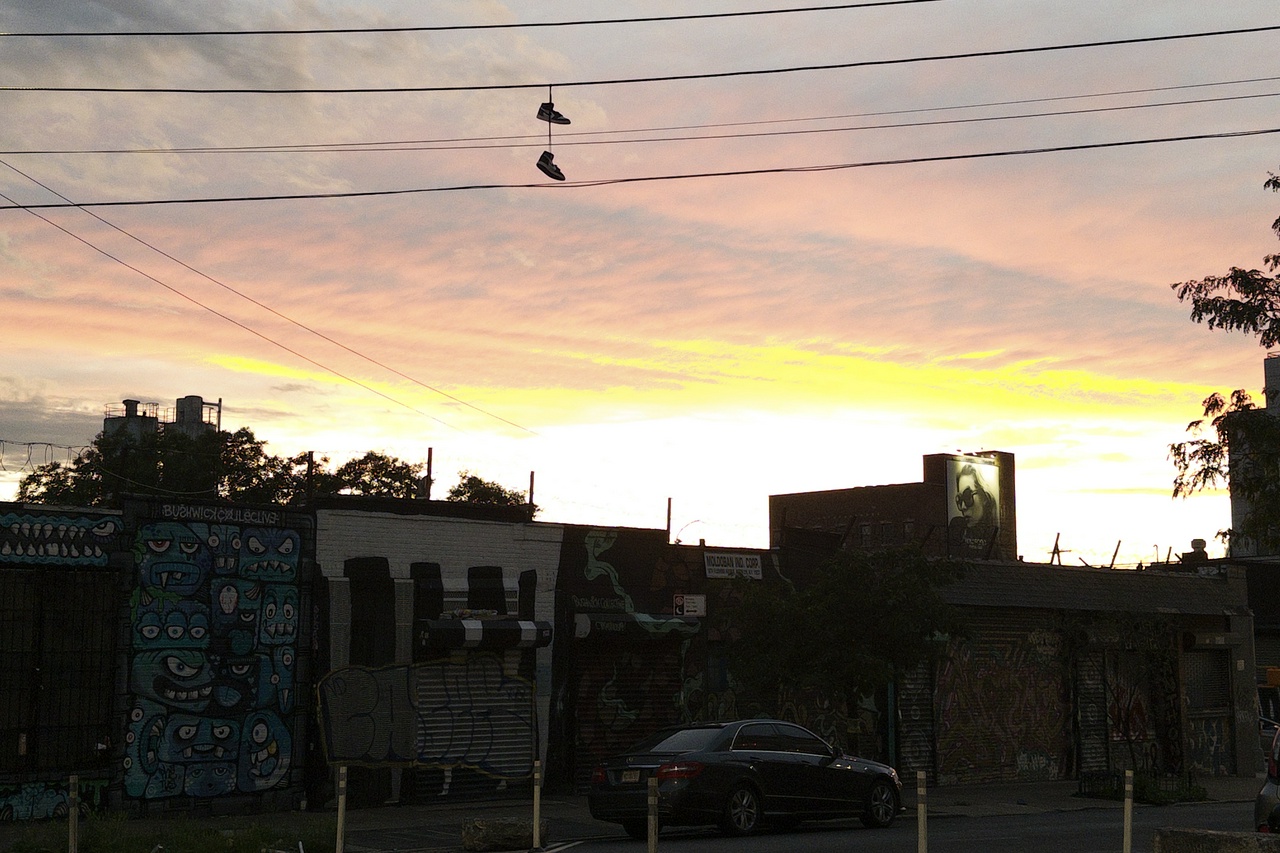
Sunset, June 23, 2026 One

Sunset, June 23, 2026 Two

Sunset, June 23, 2026 Three

Sunset, June 23, 2026 Four

Sunset 6/23/26 5

Sunset 6/23/26 6

Sunset6/23/26 7

Sunset 6/23/26 8

Sunset 6/23/26 9

Sunset 6/23/26 10

Sunset 6/23/26 11

Subset 6/23/26 12

Rain on 32nd street off 5th, truck and windows, 32nd street off 5th, afternoon 6/22/26

Rain on 32nd Street off 5th, curb, afternoon, June 22, 2026

[This is not advertising or an endorsement or a disavowal of any products or services, I'm just writing about the stuff I use.]

I recently wrote about the stuff this blog is made of; my domain registrar, platform, and email service respectively. In that spirit I want to write about the other stuff I've been using lately and how I arrived at the process I currently have. Over the years I've used so many different kinds of writing software, and I've gone from Windows to Mac and back. I mention this because it's relevant to the topic of writing software.

So like, in summary to be expanded on some other time, I was a PC person from the early 90s up until the XP era in the early aughts. And then the iPhone 3GS came out. I liked it so much that when my computer died, I got Mac and almost exclusively used Mac hardware products up until about three years ago when I took a spreadsheet class. The experience of Excel on a Windows machine was so superior to the experience on a Mac, I switched back. Throughout it all, I've been, and still am an iPhone person. As far as my position on this stuff goes, everybody should use whatever makes them happy. I don't think one is better than the other. Windows machines are more versatile. Macs are more secure. Linux is the most socially conscious.

Anyway, at different times over the years, some pieces of software were not available on whichever platform I was using, or the software was and, in some cases, still is, just better on one over the other. I experimented with Google Docs, IA Writer, Notability, Apple Notes, Google Keep, Scrivener, Microsoft Word, Microsoft OneNote, and a slew of others... Which resulted in me having a lot of writing scattered across a slew of formats. Unless I saw something through from beginning to completion in a short amount of time, it got filed away and forgotten about. I still got a buncha stuff all over the place but moved most of the important stuff to Word/Docx.

I decided when I made the switch back to PC that I would serve myself better becoming proficient at Word and Google Docs since Microsoft Office and Google Workspace are what most of the business world uses and given my making a habit of using Excel for more things instead of a bazillion different apps and services doing what a spreadsheet can do but prettier, I decided on Word. But more importantly I decided to pick one piece of writing software and stick with it exclusively. Until a couple of days ago.

My blog host is just too awesome. The CMS just works too great for markdown and uploading photos from a browser, and Word, well, doesn't do that as well. So I started out drafting in Word, and due to the friction (best word for it I can think of) I developed the bad habit of drafting directly into the CMS and publishing there... And the other day I caught myself not copy/pasting it into a Word Document and saving it immediately. I realized I need to add a little friction. Speed is nice, but the process is just too fast and I want this stuff to have a little friction to it, but not so much that it's a pain in the ass. Drafting markdown in Word is a little bit of a pain in the ass. So I was like 'What's a good markdown editor (one that isn't the CMS of write.as)?' and I've heard good things about Obsidian, but then I remembered IA Writer. I remembered the inventor of markdown really likes the iOS version so rather than try out a new thing, let me download the thing I already had but for Windows this time and see if I still like it. And, I do! I'm writing this in IA Writer right now, and I can export to Word with one click! And upon testing, it exports with all the styling looking as it's supposed to in Word.

So now I have the best of all three worlds; A place to draft for the blog that isn't the blog itself, a way to save it in .md and in .docx quickly, and the place to share it, and with just the right amount of friction to the process.

That's all for now.

-Ira

I re-download the app to my phone. I open up Facebook. There's a default feed in front of me. I don't understand it.

There's a post from UNICEF Ireland. The white text on black background reads “This week, a 12-year-old girl in a tent in Gaza was shot...” and I'll spare you the rest of the quote.

I scroll down a post. There's a humorous post from some entity I am not familiar with. The Scottish Sun. It's a picture of a handsome young man surrounded by attractive young women. The caption in the picture reads “Boston braces for Tartan Army baby boom as smitten locals enjoy kilted flings”. An accompanying quote reads “It takes a real man to rock a kilt.” I giggle.

I scroll down. There are posts from entities that I do deliberately follow. Most of them are posts about posts from other entities. ...Which is literally what I'm doing right now. For what it's worth, I'm using my own words. I navigate over to some of their pages. A lot of it is screengrabs of posts with snarky commentary or “right on” commentary. There's little to no original content.

I click on “feeds”, I click on “friends”, and there's a feed in front of me of posts from friends, and the posts are in some order I don't understand. No context is given to me that helps me understand why I'm looking at what I am looking at, in the order that I'm looking at it. It isn't chronological. Some posts are higher up. Some are further down. Some are left out altogether.

Was some of it worth seeing or engaging with? Sure. Am I any more informed about what some of my friends are up to or thinking about? Also, sure. But why do I feel like such a sucker every time I log on there?

Deep down I know why. I ignore it.

In my subconscious somewhere, I recall the stat that only 8% of Facebook interactions are between friends these days. Sounds about right. I'd say about 8% of my time and interactions there are with friends myself. How did that happen? I got trained into disconnecting from my friends by a “social” network.

The bell rings. I salivate. I remind myself that everyone is susceptible to this stuff and it is not a good use of anyone's time. Facebook may not be the only offender these days, but you can quickly trace a direct line between everybody else's behavior and Facebook's.

I snap out of it after about fifteen minutes. Thankfully, before I can even get to “reels” this time.

I navigate over to the “memories” or “on this day” feed and see if there are any tasteless old posts that need deleting. I log out. I remove my login information from my device. I get back to living life.

Repeat tomorrow. Hopefully minus the fifteen soul sucking minutes.

-Ira